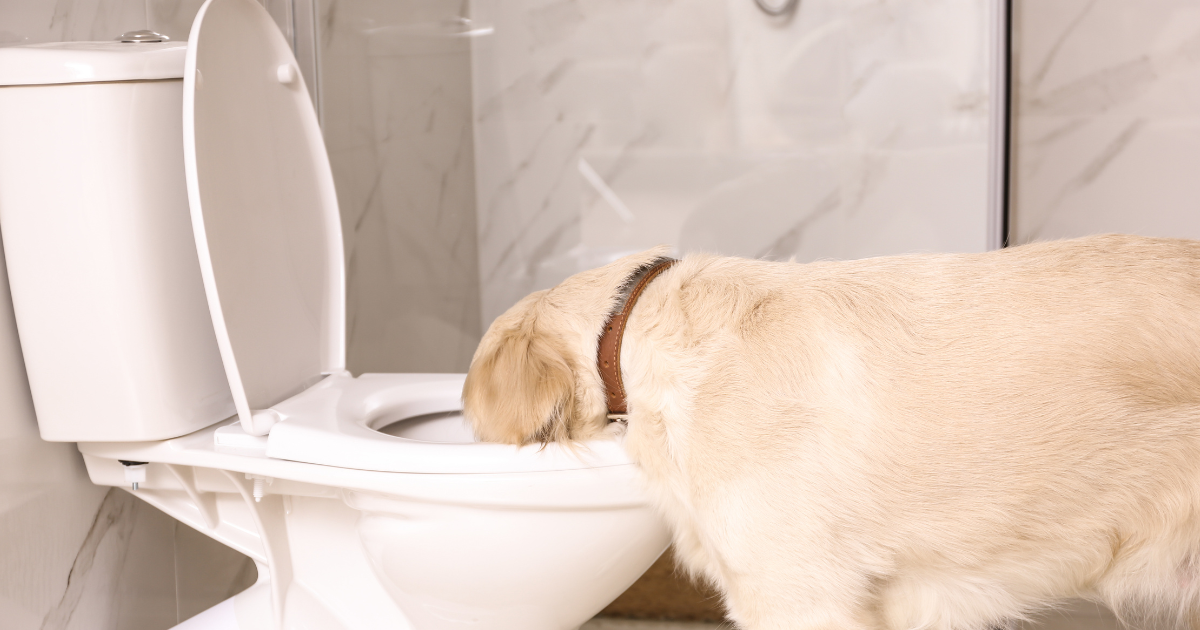
As an animal trainer, people often assume my companion animals are trained to perfection. During a livestream, I surprised a few people when I mentioned that my dog prefers to drink from the toilet.
Although I keep my toilet pretty clean—in part because I know my dog likes to drink from it—there can be concerns with this practice. Some have to do with what humans leave behind, even after flushing. Others involve the chemicals we use to clean toilets.
I can easily prevent the behavior by keeping the lid closed. But as an animal trainer, I'm interested in a different question: Why does my dog choose to drink from the toilet when he has plenty of other options?
That is where things get more interesting.
Why the Toilet When Fresh Water Is Available?
There are numerous places for my dog to access water besides the toilet. He has fresh water in a bowl on the ground in the kitchen. For most of the year, there is also a kiddie pool filled with water in the backyard, which is replenished almost daily.
Additionally, there are two water bowls on the back porch. These are often frequented by the local grackles. They steal pizza crusts from the neighboring restaurant and soak them in the bowls throughout the day. This means I need to refill those bowls frequently.
Yet despite all these options, the water source my dog seems to prefer most, when it is available, is the toilet.
Why?
Choice Can Give Us Information
One concept that has influenced how I think about situations like this is degrees of freedom, something I've learned about from mentors in behavior analysis, particularly Dr. T.V. Joe Layng, Dr. Paul Andronis, Dr. Jesús Rosales-Ruiz, Sean Will, M.S., and Maasa Nishimuta, M.S.
Degrees of freedom can be created when an animal has multiple ways to access the same critical consequence. In this case, the critical consequence is pretty straightforward: access to water.
My dog has several ways to get it. That gives me an opportunity to observe what he does when more than one option is available.
And that can give us information.
What Is Different About the Toilet?
Knowing that my dog has all these different opportunities to access water but frequently uses the toilet when he can tells me there may be something about accessing water from the toilet that is different from the other options.
That causes me to look more closely at the variables involved.
Two features stand out to me.
My dog is a pit bull mix. As a medium- to large-sized dog, the toilet puts the water at a height that allows him to drink without having to lower his head as far as he does with a bowl on the ground.
I've also observed that he seems to prefer freshly replenished water. Whenever I am filling the water bowls outside, he often comes over immediately to drink. And one water source in the house is probably replenished with fresh water more frequently than any of the others—the toilet.
Are those variables influencing his behavior? I don't know yet.
But they give me something I can test.
For example, will increasing the height of his regular water bowl change which water source he visits more frequently? What happens if I replenish the other bowls more frequently?
I haven't formally tested these possibilities, so at this point they remain hypotheses. But that's part of what makes degrees of freedom so useful. When animals have meaningful alternatives, their behavior can help us identify variables we might otherwise overlook.
Will increasing the height of this water bowl change which bowl my dog visits more frequently?
Preference Is Information, Not an Explanation
It would be easy to stop at, “He prefers drinking from the toilet.”
But preference describes what I'm observing. It doesn't necessarily explain why it is happening.
Giving him several ways to access water allows me to start asking better questions. Is it the height of the water? Freshness? Location? Temperature? Something else I haven't considered?
If I manipulate some of those variables and his behavior changes, I have learned something useful.
This same idea can be applied to much more important training situations. When animals have several ways to access something that matters to them, their selections can reveal variables influencing behavior that may not have been obvious to us.
Sometimes the Obvious Reinforcer Isn't the Whole Story
A relatable human example might be working for a paycheck.
Many of us have probably considered taking another job because the pay was better. But perhaps the work environment wasn't as satisfying as the one we already had, even though the current job paid less.
Money certainly matters, but it may not be the only variable influencing our behavior. Working conditions, colleagues, flexibility, location, opportunities, and many other factors can influence which option we select.
Animal training situations can be similar. We may identify an obvious reinforcer and assume we understand why an animal is participating. But other variables may also be influencing behavior.
Providing more degrees of freedom can help reveal some of them.
The Bigger Lesson for Animal Trainers
The toilet bowl isn't really the important part of this story. The bigger lesson is what can happen when we give animals more than one way to access something that matters to them.
Expanding degrees of freedom doesn't just give the animal more options. It can give us more information.
When an animal consistently selects one option over another, hesitates, disengages, or changes strategies, those patterns can prompt us to look more closely at the variables influencing behavior. Rather than assuming we already know why an animal participates—or doesn't—we can arrange meaningful alternatives and let behavior help inform our next questions.
Sometimes even a dog drinking from a toilet can turn into a behavior analysis lesson.

About Barbara Heidenreich
Barbara Heidenreich is a zoologist and animal training and behavior consultant specializing in species managed in zoological facilities. She earned her B.S. in Zoology from the University of California, Davis. Barbara consults internationally with zoos, universities, veterinary professionals, and conservation programs and has worked onsite with more than 90 facilities in 30 countries.
In addition to her consulting work, Barbara serves as an Adjunct Instructor at Texas A&M University and operates AnimalTrainingFundamentals.com, a comprehensive online education program offering hundreds of courses on animal training and behavior. Her work focuses on applying behavior analysis to improve animal welfare through building behavior, contingency analysis, genuine choice, and constructional approaches to behavior change.
Barbara has authored two books, contributed to five textbooks, and co-authored two Fear Free® Avian Certification Courses. She advises the Animal Training Working Group and Parrot Taxon Advisory Group for the European Association of Zoos and Aquaria and serves as Co-Chair and founding member of the Zoological Association of America’s Animal Training Committee. She has contributed to conservation projects including the Kakapo Recovery Program and the Borneo Orangutan Survival Foundation and has received seven awards from zoological trade organizations recognizing her contributions to the field.
There’s More to Explore
Discover courses, articles, tools, and resources across Animal Training Fundamentals
Keep the Learning Going: Join My Mailing List
Get notified about new live-streams, events, workshops and more!
BECOME A MEMBER FOR EXTENSIVE BENEFITS


